Project / Demo
Disappearing milk
Reproducing a demonstration my friend Iosif saw as a kid: add enough sugar to milk and it turns transparent — a lesson in refractive-index matching.
A few years back I was having lunch at my friend Iosif's house when he told me about a physics demo he saw in high school in the USSR (Uzbekistan): they added salt or sugar (he couldn't remember which) and the milk turned transparent. I finally did some thinking about it and tried to reproduce it.
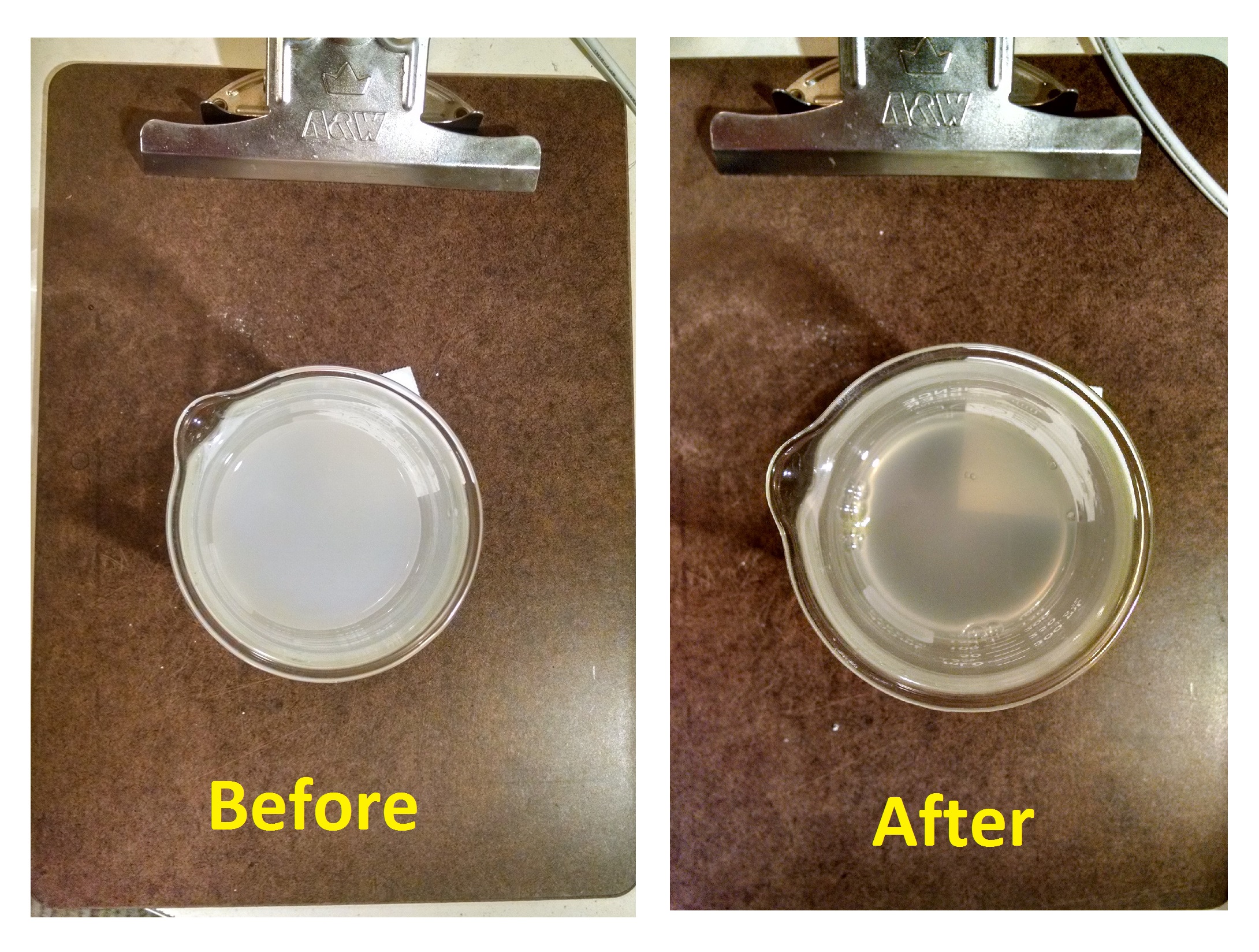
Searching the internet I couldn't find anything on it, so I tried it myself — and only afterward found a solitary mention in the literature [1].
Why milk is white in the first place
Milk appears white because of the fat droplets in suspension. Fat has a refractive index of about nfat ≈ 1.46 [2], while water is about nwater ≈ 1.33. Because of this mismatch, light scatters off the microscopic fat droplets and little makes it through. If you match the index of the surrounding liquid to that of the fat, you eliminate the scattering. I add sugar to the water to raise nwater until it matches the fat.
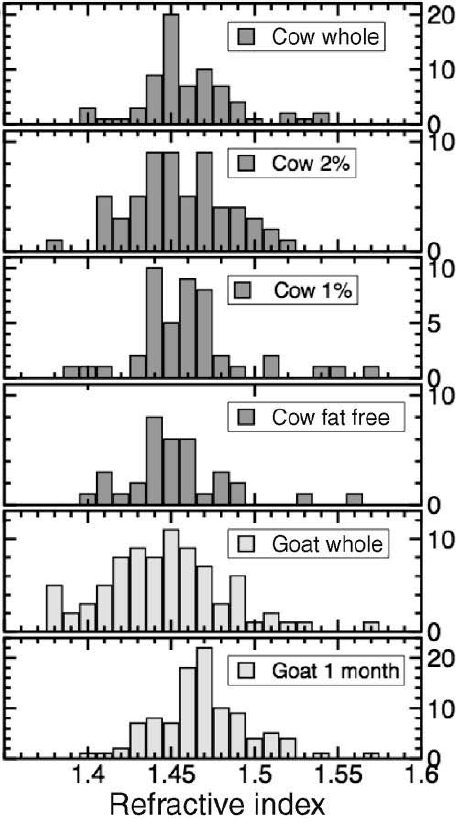
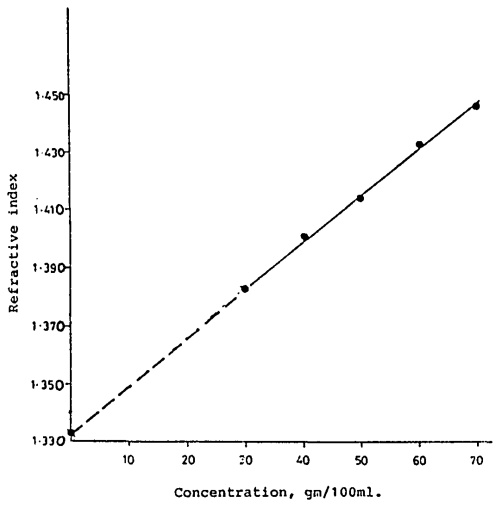
From reference [3], the fat droplets have nfat = 1.468 ± 0.035. From reference [4], the index of sugar water goes roughly as n(c) = 0.002 × c + 1.324, where c is the sugar concentration in g / 100 mL. Putting the two together, about 73 grams of sugar in 100 mL of water should match the two indices.
Practical advice
This takes some time to get right — the photo at the top was my first attempt. Next time I'd saturate a sugar–water mixture separately and add that, so you don't have to wait for sugar to dissolve in the milk.
Acknowledgements
I'd never have tried this if Iosif Shinder hadn't told me about it — thanks.
References & further reading
[1] The whiteness of things and light scattering, L. M. Gratton et al.
[2] Optical parameters of milk fat globules for laser light scattering measurements, Michalski et al.
[3] Characterizing individual milk fat globules with holographic video microscopy, F. C. Cheong et al.
[4] Refractive index of solutions at high concentrations, W. Mahmood et al.