Research
Research statement
Two intertwined threads — fluid flow metrology and the dynamical-systems view of turbulence — and where I want to take them next.
Introduction
My research interests have so far been mainly in two areas: fluid flow metrology and fluid turbulence. I started out interested in the instrumentation and measurement of fluid flow. Studying ways to improve flow metrology made it apparent that at the heart of most metering challenges lies turbulence. Turbulence has been formally studied since da Vinci more than 500 years ago, almost always with statistical methods. More recently the role of coherent structures such as vortices has been investigated, but without tremendous success. Using the tools of chaos theory and dynamical-systems theory applied to the governing equations of fluid motion, it may be possible to discover the role of these coherent structures — and even exploit them to predict and control turbulence. My current research aims to test the validity of a dynamical-systems description of turbulence and to develop techniques that help predict and control it.
Research activities
Previous work in fluid flow metrology
While working in the Fluid Metrology group at NIST, I helped maintain primary flow standards and improve calibration techniques — developing physical models and uncertainty analyses for primary flow standards, designing and running wind-tunnel experiments, and maintaining both liquid and air flow primary standards.
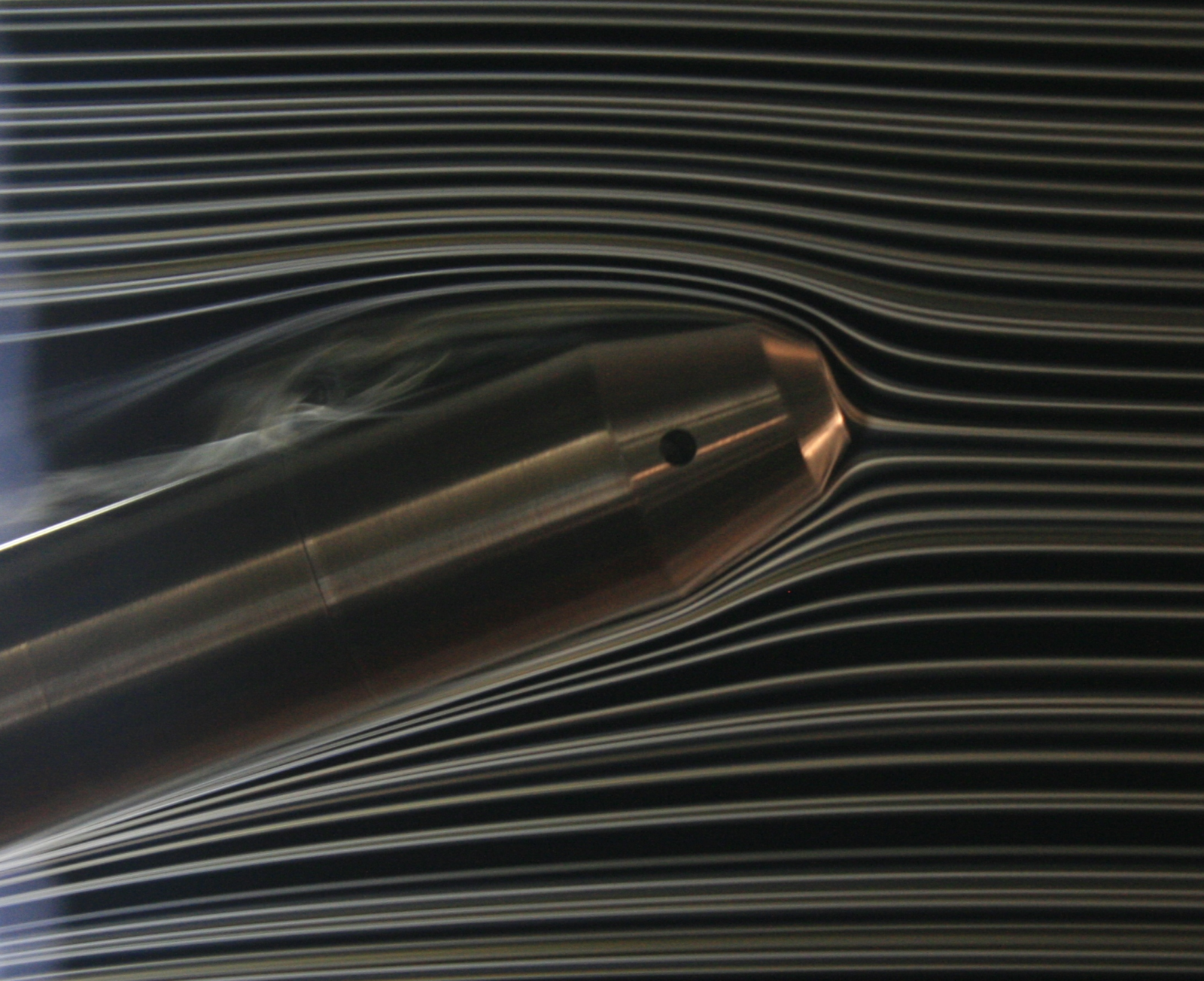
Airspeed traceability
To measure the efflux of greenhouse gases and pollutants from coal-burning power-plant smokestacks, permanently installed flow meters and gas-composition instruments are used, following an EPA-mandated calibration procedure. That procedure recommends a conically shaped multi-holed pitot tube — but we discovered this instrument undergoes a flow transition just above the boundary layer that can throw readings off by as much as 30%. The transition results from a flow instability that depends strongly on turbulence intensity. Investigating it made clear that the industry's calibration philosophy was wrong: rather than calibrating in the most stable environment, an anemometer should be calibrated in an unsteady flow environment matching where it will be used. In the past few years the national-standards-lab literature has begun to reflect this new philosophy.
Dynamic gravimetric flow-meter calibration facility
In the early 2000s, I. Shinder and M. Moldover at NIST developed a method for calibrating liquid flow meters by tracking the mass collected in a tank over time on a weigh scale; the time-derivative of the mass reading is the mass flow rate to second order, despite the impinging momentum jet. It had only been implemented in a large-scale facility at a stable flow rate. By building a smaller-scale facility with an easily varied flow rate, we showed the method also allows calibration of the dynamics of flow meters.
Improvements to liquid flow-meter calibration
Liquid flow measurements matter everywhere from the gas pump to the cooling water in a nuclear reactor core, and high-quality measurements need high-fidelity calibration facilities. These labs used a surrogate for JP-8 jet fuel that is less flammable but a known carcinogen. Working with the Air Force's Primary Standards Lab, we established a new, non-toxic working fluid — aqueous propylene glycol — that reliably matches the rheological properties of JP-8.
Current research in fluid turbulence
I work in the Pattern Formation and Control Lab in the Georgia Tech physics department, validating a dynamical-systems description of fluid turbulence. The theory says there exist special, dynamically relevant solutions of the Navier–Stokes equation — stable along most dimensions of their (practically enormous) state space and unstable along only a few. Trajectories leaving these unstable solutions trace out curves that connect to other solutions, forming dynamical connections that act as a road map for where a chaotic trajectory goes next. In theory this offers wonderful insight into the time evolution of turbulence — but how well does it work in a real turbulent flow?
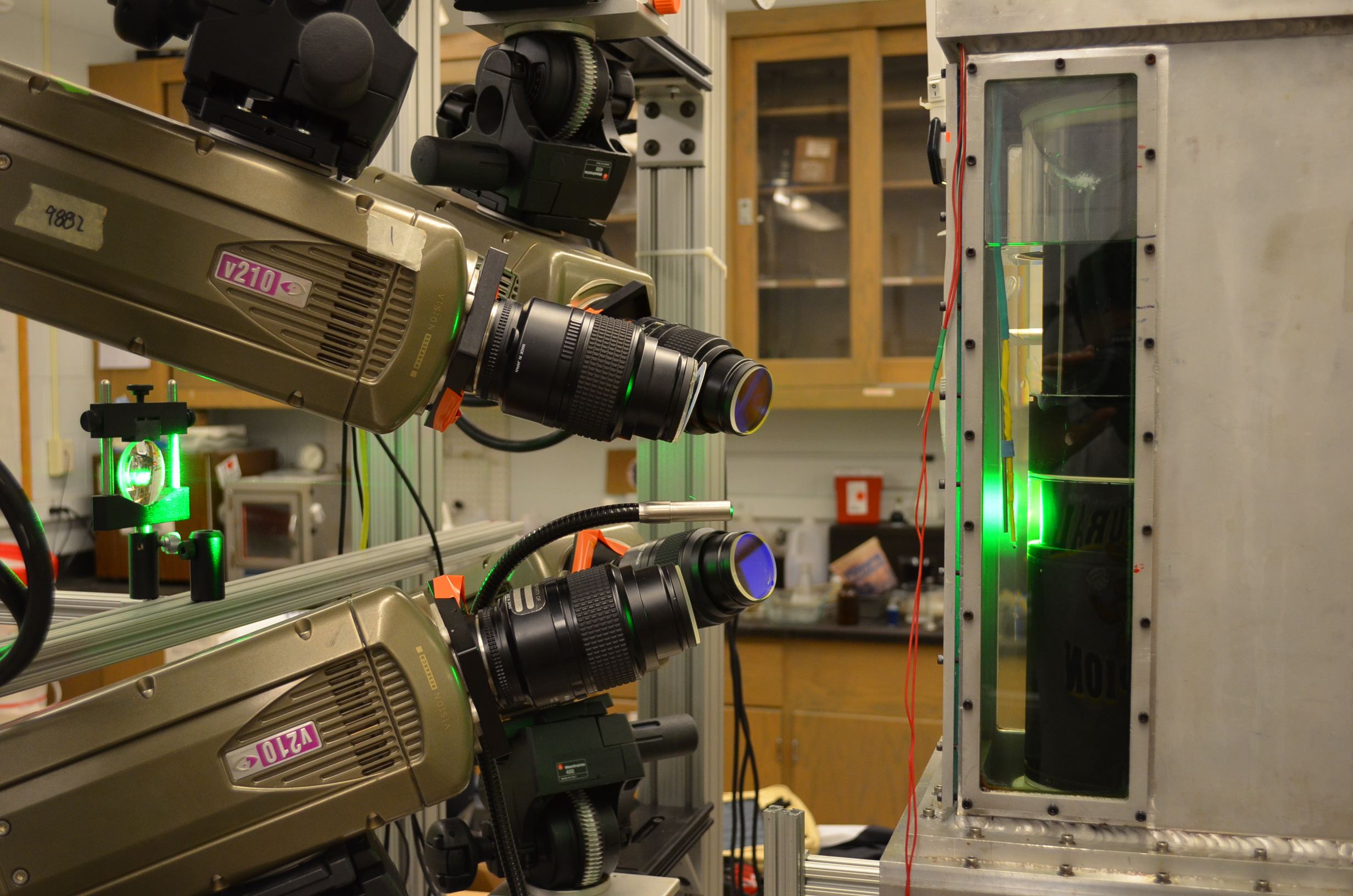
To test the model, fully time-resolved, high-resolution, 3-D turbulent velocity fields must be compared with numerically computed unstable solutions of the Navier–Stokes equations. I use a custom, fully time-resolved tomographic Particle Image Velocimetry (tomo-PIV) setup to obtain high-resolution velocity fields of counter-rotating Taylor–Couette flow in the small-aspect-ratio regime. The Navier–Stokes simulations use spectral methods, and solutions are found with a Newton–Krylov algorithm.
Future work
Once the validity of a dynamical-systems description is established, I intend to turn to controlling turbulence. Using finite-amplitude perturbations — tiny, well-timed kicks — you should be able to move the system into a region of state space that evolves along a dynamical connection for long periods, steering turbulence with minimal energy.
One of the first places to test this is the transitional regime between laminar and turbulent flow. For moderately turbulent flows there are dynamical links between the chaotic turbulent attractor and the stable laminar attractor. By kicking the system near one of these special connections, you should be able to coax it to relaminarize — which requires first finding the edge states whose unstable submanifolds connect to both regions, then mapping those submanifolds and designing the optimal perturbation.
A copy of my Ph.D. thesis proposal can be found here.